Mosquito Control
Pathways to control invasive diseases in Hawai'i's birdsMosquito Control
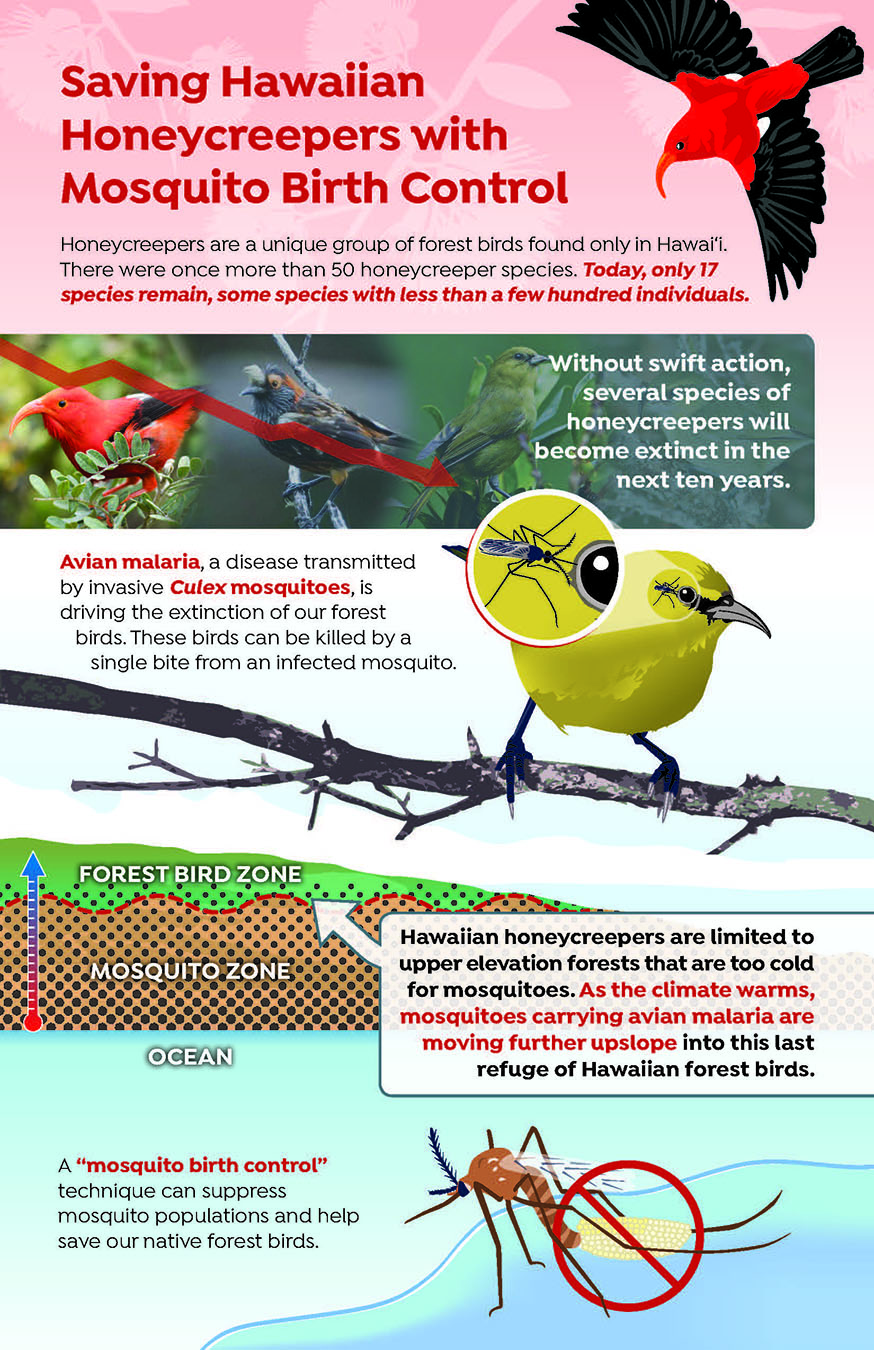
Birds, Not Mosquitoes is a multi-agency partnership urgently working to protect native Hawaiian honeycreeper birds from extinction. The non-native southern house mosquito (Culex quinquefasciatus) is invading these birds’ habitats and spreading deadly avian disease.
MFBRP is working together with conservation partners to research and apply innovative mosquito control techniques in Hawai’i. These conservation efforts are focused on how to reduce the population of disease-carrying mosquitoes in the remaining native forest bird habitats.
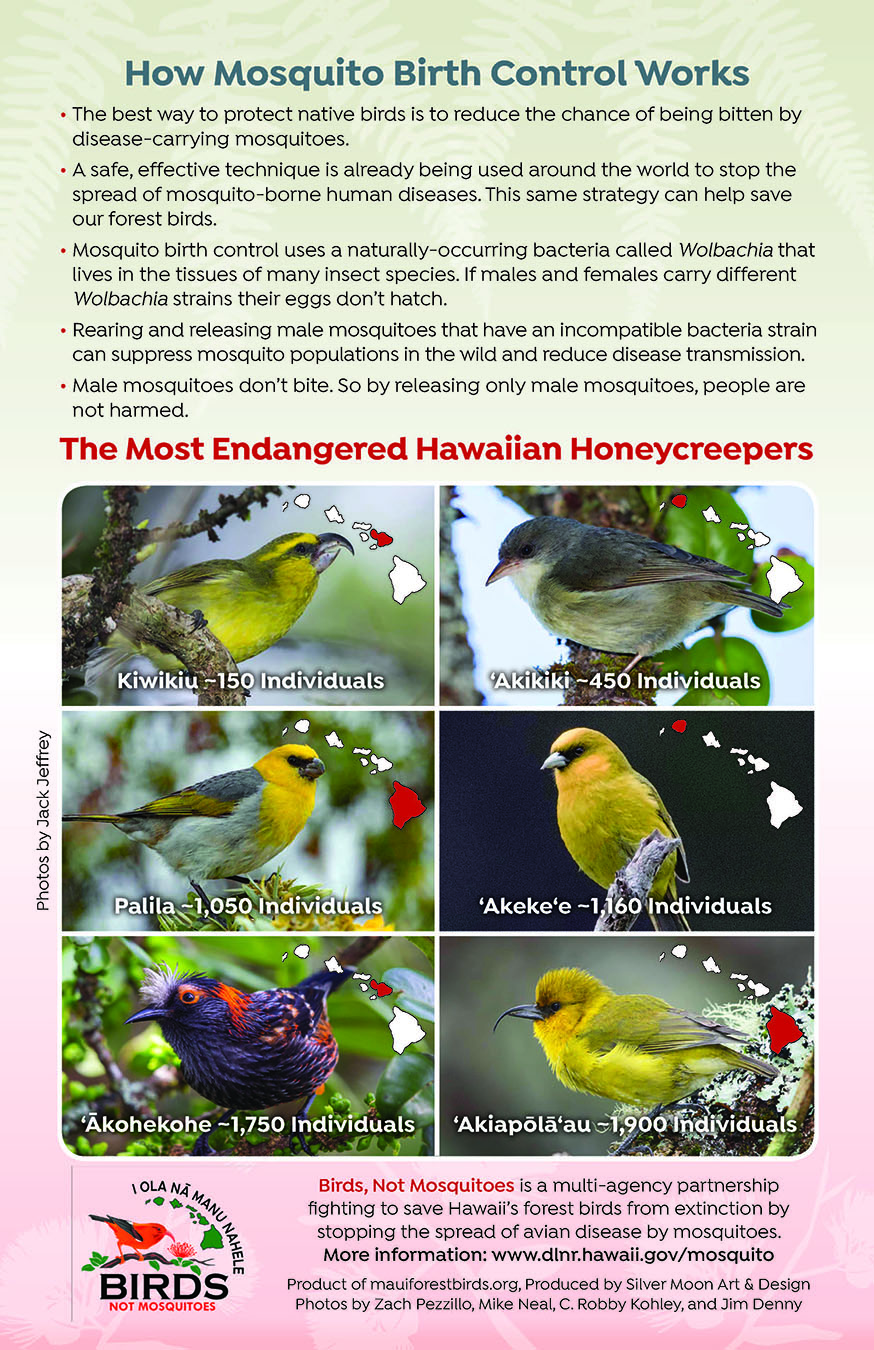
The current strategy is Incompatible Insect Technique (ITT) using Wolbachia, a naturally-occurring bacteria known to help suppress mosquito populations. This approach uses mass-reared male mosquitoes with a different, incompatible strain of Wolbachia than the wild female mosquitoes already found in Hawai‘i. With different strains of Wolbachia, the males and females can’t produce viable offspring. Because offspring aren’t fertilized, they can’t hatch and add to the mosquito population. This over time reduces the overall mosquito population. For more, see Birds, Not Mosquitoes. Watch this video below for more information.
This approach was reviewed at multiple levels (for example: workshop report) and went through rigorous regulatory pathways before moving forward. We are continuing to research the effects of this control and the response of native ecosystems.
The success of any pest management uses multiple pathways towards reduction. To reduce mosquito populations, we are not only using IIT Wolbachia male mosquitoes, but also biological insecticides (for example, BTI) that target mosquito larvae (see Research). If mosquito breeding occurs, we can eliminate larvae prior to them developing into adults that can potentially spread disease. In addition to these methods, organizations are working to restore native forest and reduce mosquito habitat. For instance, planting native trees increases bird habitat and fencing out and eliminating ungulates from native forests reduces mosquito habitat. You can help to reduce mosquito populations in your own yards.
See MFBRP in the News, Newsletters, and Publications for more information.
The project is funded in part by the American Bird Conservancy, Hawaiʻi Department of Land and Natural Resources, U.S. Fish and Wildlife Service, National Fish and Wildlife Foundation, and the Hawaiʻi Invasive Species Council.