Disease Research
Understanding Disease and Mosquito Impacts
Avian Disease
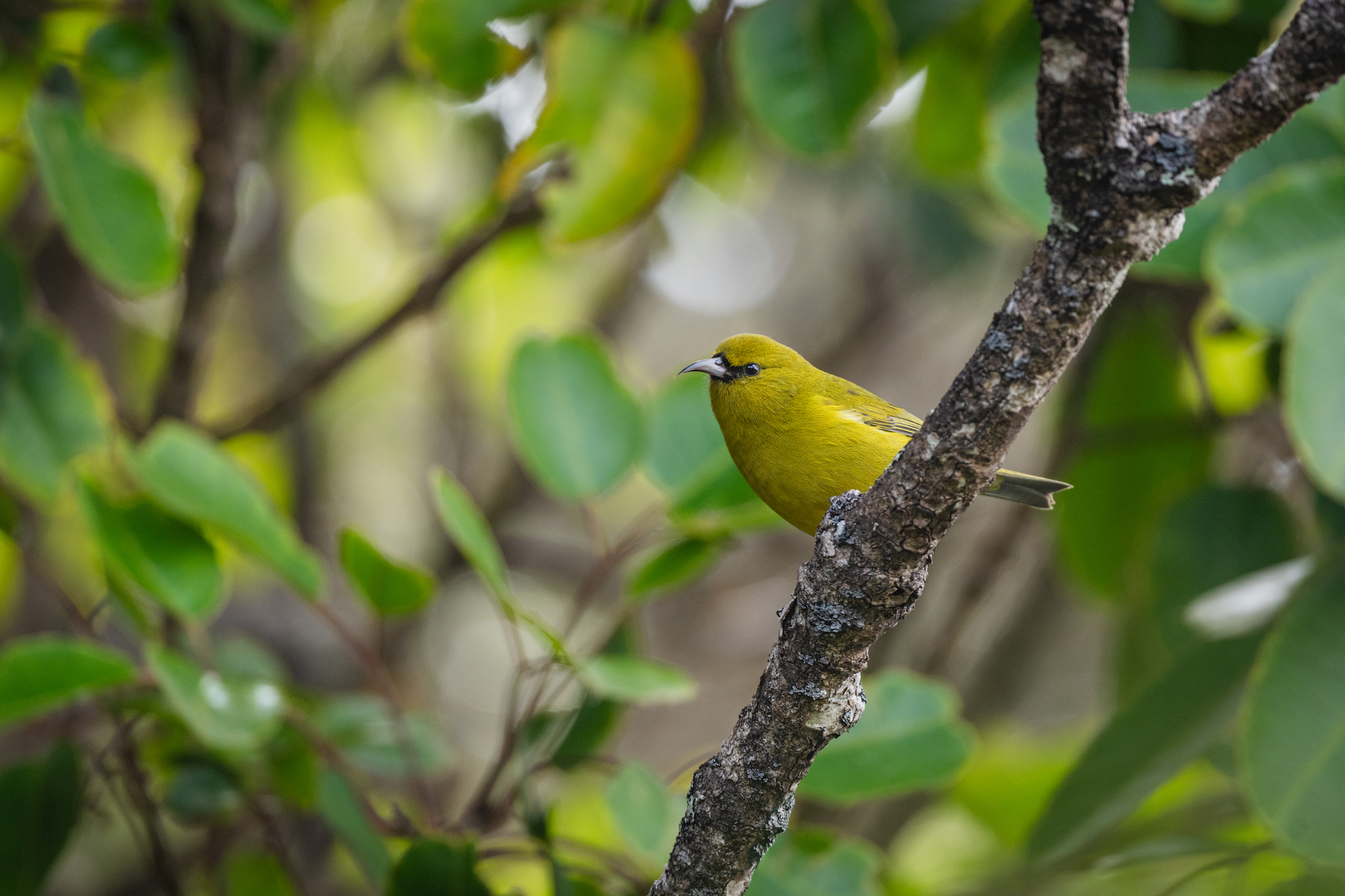
We work to give Hawaiʻi’s honeycreepers a chance at survival. Mosquito control is essential to prevent the spread of disease.
Mosquitoes and the Hawaiian Islands
There are no native mosquitoes in the Hawaiian Islands. Mosquitoes arrived with whaling ships and other shipping activity in the 1800s. The southern house mosquito (Culex quinquefasciatus), introduced in 1826, is the primary transmitter of Avian Malaria and Avian Pox. These diseases are continuing to cause declines and extinctions of Hawaiʻi’s native forest birds.
Most native Hawaiian honeycreepers now only survive in high-elevation native forests. On Maui, these forest areas are largely found on the northeastern slopes of Haleakalā, above 5,000 feet (1,200 m) elevation, where cooler climates limit mosquito populations and disease transmission.
Species like kiwikiu and ‘ākohekohe once thrived in low and mid-elevation forests but are now restricted to a tiny sliver of their historic range due to mosquito-spread diseases. Although some suitable habitat remains at lower elevations, these areas are infested with southern house mosquitoes and are largely uninhabitable. Birds venturing lower in elevation often become infected with avian malaria and die. Climate change is exacerbating this crisis. As rising temperatures allow mosquitoes and disease to invade higher elevations, this shrinks the already limited range of Maui’s native forest birds.

The Diseases
Avian Malaria is only spread by mosquitoes and is caused by a microorganism called Plasmodium relictum. The disease infects birds’ red blood cells, causing them to rupture which leads to low blood oxygen levels. It also results in enlargement and damage to internal organs such as the liver and spleen. Having poor immunity to the disease, many Hawaiian honeycreepers quickly become anemic, lethargic, and often die. Individuals that manage to survive the initial stage of infection may remain chronically-infected for life. This weakens their immune system and turns them into persistent reservoirs for further transmission.
Avian Pox Virus was first documented in forest birds in 1902. It is primarily transmitted by mosquitoes but can also spread by direct contact between infected birds, contaminated surfaces, and contaminated food and water. Symptoms include swollen, tumor-like lesions on unfeathered parts of a bird’s body, like the feet, legs, eyes, and base of the bill. Lesions can also occur in the mouth, trachea, esophagus, and lungs. These lesions impact the bird’s ability to eat, forage, and fly. Infected birds that do not die immediately from disease become weak and emaciated, and ultimately struggle to survive.
Disease Control and the Future
The survival of Hawaiʻi’s native forest bird populations depend on minimizing introduced mosquito populations and disease, preservation and restoration of forest habitat, and the elimination of introduced predators.
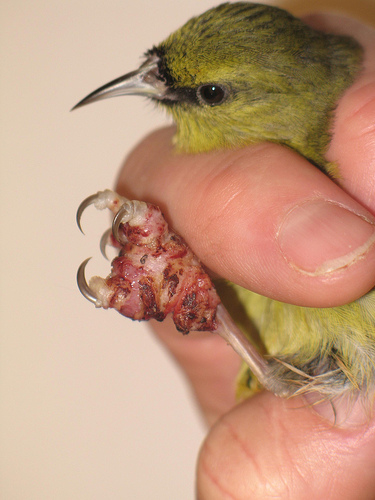
This Hawaiʻi ʻamakihi has debilitating avian pox on its foot.
Mosquito Research and Monitoring
Our current mosquito research and monitoring efforts include using traps to capture adult mosquitoes and the eggs that they lay. The survival of Hawaiʻi’s native forest bird populations depends on minimizing introduced mosquito populations and disease; we are actively working to understand the parameters of these mosquito populations and the extent of mosquito-borne disease.
There are many trapping techniques used to collect samples, each used for different purposes.
To collect eggs:
Ovibasins are black basins about 3 inches deep, 12 inches wide, and 24 inches long. They are filled with “stinky water,” a mixture of water and fermented hay, and used to collect eggs laid by female mosquitoes. The purpose of the “stinky water” is to attract a certain species of mosquitoes that prefer mucky, stagnant water for their larvae. Once eggs are laid, our field team collects them by scooping them with a paint brush and placing them in a petri dish.
To collect adult mosquitoes:
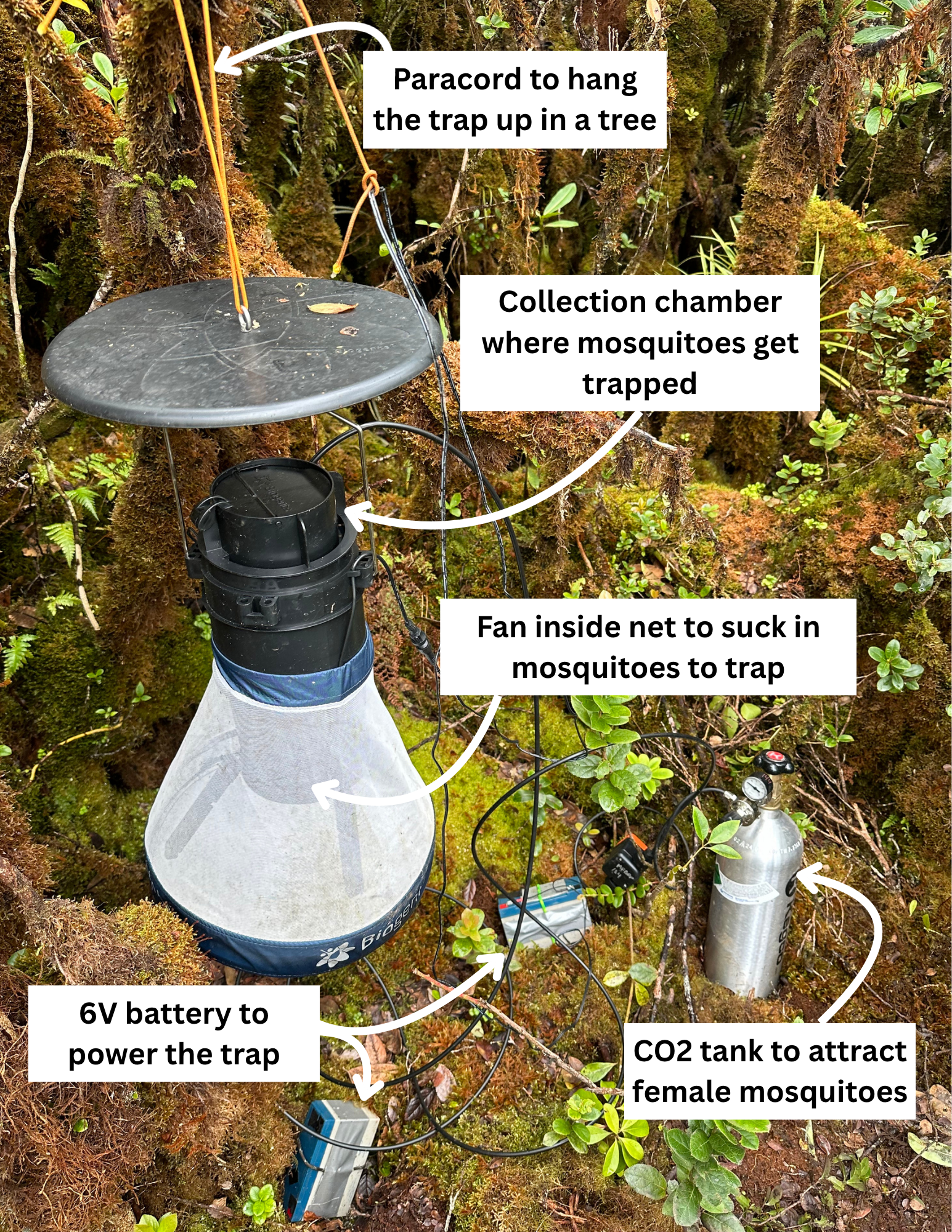
BG Pros and Sentinels: These traps are used to collect female and male mosquitoes on the landscape using a combination of CO2 and “stinky lures” – both of which attract mosquitoes. These traps consist of a trap body which holds a fan that creates a constant suction. This suction allows mosquitoes to be captured when they get close enough to the opening of the traps. Once sucked into the trap, the mosquitoes are held in a net bag which we collect each day. These net bags filled with captured mosquitoes are then brought back to the MFBRP lab where our team can identify the species and sex of each mosquito using a microscope.
Vanishing Voices: Saving our Hawaiian Forest Birds
Below is a short documentary about mosquitoes, their impact on native forest birds, and the ongoing efforts to protect Hawaiian honeycreepers.