Opportunities at MFBRP
Employment Opportunities
Contribute to preventing extinctions and caring for Hawaiian ecosystems. Hawaii’s iconic honeycreepers are facing an extinction crisis and we need your help!
Mosquito-spread disease threatens Hawaiian honeycreepers with extinction and our mosquito control work is their last best hope. We are seeking dedicated crew members to join our research team on the front lines of mosquito control and endangered species management.
_____________________________________________________________________
MOSQUITO RESEARCH/CONTROL ASSISTANT COORDINATOR
We are seeking an assistant coordinator to join our team on the front lines of endangered species management. The ideal candidate will have strong organizational skills, remote field experience, and a scientific background, especially in entomology or vector control. Join us and you can directly contribute to preventing wildlife extinctions and caring for Hawaiian ecosystems.
SUMMARY OF DUTIES:
Plans, prioritizes, and implements the deployment of landscape level mosquito control on Maui for the benefit of native wildlife. Develops, implements, and manages all project activities including research, conservation management, field work and logistics, budget tracking and regulatory compliance. Liaises with partners to monitor and implement impact abatement, control of introduced species and/or habitat restoration in study areas. Develops annual work plans and reports for submission.
Ensures that proper environmental compliance documentation is prepared for all projects and that all permits and regulatory approvals are obtained. Takes the lead in analysis and interpretation of field data. Writes grant proposals and carries out routine awareness-raising events to ensure ongoing project funding. Plans public outreach efforts, working with media, community organizations, civic leaders, and individuals through an effective program using personal contact, media briefings, brochures, press releases, presentations and public service announcements. May travel to other islands for site visits and fieldwork.
PRIMARY QUALIFICATIONS:
EDUCATION Master’s Degree from an accredited college or university in Biological Sciences, Resource Management, Planning, or related field. (Bachelor’s Degree from an accredited four (4) year college or university and at least two (2) years of independent research in conservation of endangered avian species may substitute for a Master’s Degree.).
EXPERIENCE Three to five (3-5) years of experience conducting biological research, entomology, invasive species management, or conservation management.
KNOWLEDGE Working knowledge of the principles and techniques of conservation management, remote field operations, and invasive species biology. Working knowledge of natural history relevant to native Hawaiian wildlife, or similar environments. Working knowledge of native Hawaiian ecosystems, native Hawaiian plants and wildlife, or similar environments. Proficient knowledge of techniques used to inventory and monitor wildlife, and other natural resource assets, including experimental design and data analysis.
ABILITIES & SKILLS Strong organizational ability to plan, lead, and execute logistically complex field operations. Strong ability to solve logistical problems and innovate solutions related to biological threats. Ability to lead a field crew and work as a team member for safe and efficient field operations. Ability to maintain a positive professional attitude in support of a productive work environment. Must have excellent communication and program management skills. Ability to analyze data and present findings and recommendations in written report format. Ability to estimate costs associated with complex projects and to project budget requirements for future program needs. Proficient use of Microsoft Office word processing, database, and spreadsheet programs. Ability to perform basic statistical analysis. Ability to lead data management and analysis, and demonstrated ability in publishing peer-reviewed scientific papers. Proven grant writing and fund-raising abilities. Must possess a valid driver’s license (and if use of personal vehicle on the job is required, must also have valid personal driver’s insurance equivalent to Hawai‘i’s No-Fault Driver’s Insurance) and maintain throughout the duration of employment. Must complete the online Hazard Communication training immediately after hire or no later than employee’s initial exposure to hazardous chemicals. Must be able to complete basic helicopter safety course (A100) within twelve (12) months from date of hire.
PHYSICAL/MEDICAL DEMANDS Must be able to conduct fieldwork in dense vegetation and remote areas under difficult conditions (e.g., heat, rain, cold temperatures, poor footing). Must be able to hike over difficult terrain and long distances of twelve to fifteen (12-15) miles with a backpack weighing up to forty (40) pounds unassisted. Must be able to work around and fly in approved helicopters.o lead a field crew and work as a team member for safe and efficient field operations. Ability to maintain a positive professional attitude in support of a productive work environment. Must have excellent communication and program management skills. Ability to analyze data and present findings and recommendations in written report format. Ability to estimate costs associated with complex projects and to project budget requirements for future program needs. Proficient use of Microsoft Office word processing, database, and spreadsheet programs. Ability to perform basic statistical analysis.
SECONDARY QUALIFICATIONS:
PhD from an accredited college or university in Biology or related fields. Management, public relations, and administration skills. Knowledge of funding sources in Hawai‘i and nationally. Experience coordinating with land managers in Hawai‘i. Field experience with mosquitoes. Expertise in database design and management. Experience with drone use for conservation benefits and other cutting-edge innovations.
** Pay $5,742.65 – $5,973.12/Month. 2-year term, full-time. Temporary communal housing is available.
INQUIRIES: Hanna Mounce 808-421-7483 (Maui).
___________________________________________________________________
Housing on Maui is limited. While we consider all qualified applicants for open positions, we strongly recommend applying if you already have a secure housing situation on island.
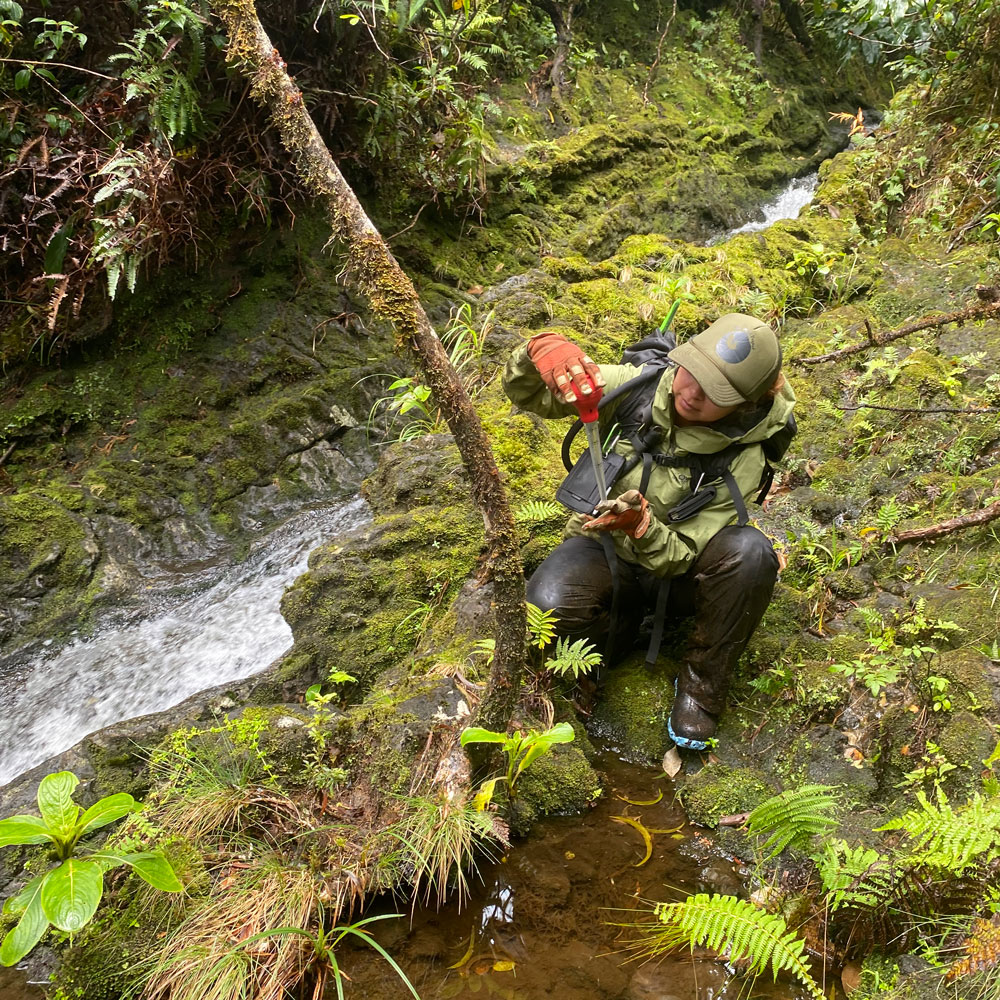
Come work with us!
Graduate Student Research
MFBRP occasionally coordinates and conducts research with graduate students whose projects are focused on Maui’s native birds and forest ecosystems.
These projects are co-advised through an external university advisor and MFBRP. Financial responsibilities are up to the student, but MFBRP may be able to help identify and procure funds. MFBRP may be able to provide housing, office space, data support, field logistics, and equipment. Each student and project is reviewed on a case by case basis. For more information, please contact infoATmauiforestbirds.org.
Here is a selection of past research:
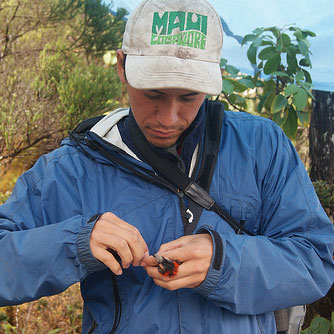
‘Ākohekohe Movements
Investigation of the dispersal of ‘ākohekohe. Alex Wang used radio-telemetry to document ‘ākohekohe movements and conduct foraging observations of both adults and juveniles.
Alex found that adults tended to stay in the same general area, whereas juveniles roamed over much larger areas. These long-distance juvenile movements led a few individuals to dip lower in elevation, where higher densities of mosquitoes can persist. This increases the risk for disease exposure.
Wang Alex X, Paxton E.H, Mounce H.L, Hart PJ. 2020. Divergent movement patterns of adult and juvenile ‘Akohekohe, an endangered Hawaiian Honeycreeper. Journal of Field Ornithology.
Wang AX. 2014. The presence of an ecological trap in the juvenile dispersal of the ‘Ākohekohe (Palmeria dolei), a population limiting life stage Poster Presentation. Hawai’i Conservation Conference, Honolulu, HI.
Kiwikiu Genetics
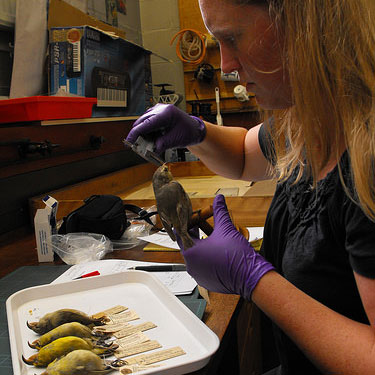
Genetic diversity (the variability of genes in a species) is fundamental to biodiversity and is important to the overall health of populations. MFBRP manager, Hanna Mounce, used microsatellites and mtDNA sequence data to analyze the current and historic population structure and diversity of kiwikiu.
Decreased genetic variability leads to increased levels of inbreeding, reduced fitness, and could accelerate species extinction. Hanna’s research provides information on the current genetic diversity of kiwikiu in the wild. This data has informed management decisions on behalf of kiwikiu survival.
Non-native Forest Use
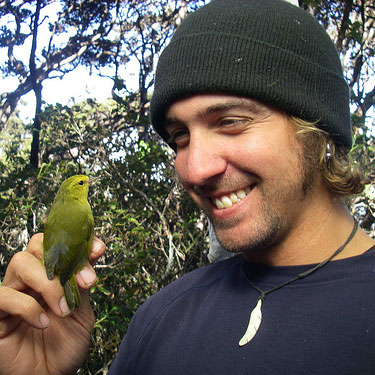
Due to extensive habitat destruction, the Maui ‘Alauahio occurs in two known disjunct populations where habitat conditions vary extensively. The primary population in high elevation native forests and the secondary population in non-native forest sites.
Graduate student Peter Motyka investigated the use of non-native forest by native birds to facilitate informed management of non-native forest for the benefit of native forest bird species. The project included color-banding and resighting Maui ‘Alauahio, quantifying vegetation structure for foraging habits, conducting variable circular plot point counts for bird densities, and nest searching and monitoring.
Because of this study on native bird use of non-native forest, MFBRP continues to conduct point counts and monitor native bird disease prevalence studies in non-native forest sites.