Opportunities at MFBRP
Employment Openings
Please note that housing on Maui is extremely limited. While we will consider all applicants for the open positions that we have, we recommend applying if you are already in, or have, a secure housing situation on Maui.
We have no openings at this time. Please check back with us for upcoming opportunities.
Graduate Student Research
MFBRP occasionally coordinates and conducts research with graduate students focusing on birds and ecosystems on Maui, helping to achieve MFBRP project goals.
These projects are co-advised through an external university advisor and MFBRP. Financial responsibilities are up to the student, but MFBRP may be able to help identify and procure funds. MFBRP may be able to provide housing, office space, data support, field logistics, and equipment. Each student and project is reviewed on a case by case basis. For more information, please contact infoATmauiforestbirds.org.
Here is selection of past work:
‘Akohekohe Movements
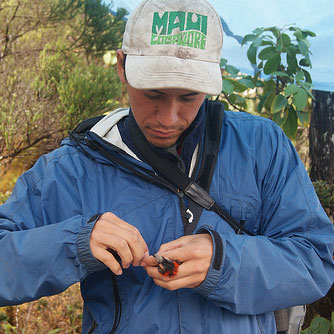
Investigation of the dispersal of ‘ākohekohe. Alex Wang used radio-telemetry to document ‘ākohekohe movements and take foraging observations of both adults and juveniles. He was able to record hourly and daily movements, monitoring foraging and breeding habits as well.
Alex found that adults tended to stay in the same general area, whereas juveniles roamed over much larger areas. These long-distance juvenile movements led a few individuals to dip lower in elevations, where higher densities of mosquitoes can persist. This increases the risk for disease exposure.
Wang Alex X, Paxton E.H, Mounce H.L, Hart PJ. 2020. Divergent movement patterns of adult and juvenile ‘Akohekohe, an endangered Hawaiian Honeycreeper. Journal of Field Ornithology.
Wang AX. 2014. The presence of an ecological trap in the juvenile dispersal of the ‘Ākohekohe (Palmeria dolei), a population limiting life stage Poster Presentation. Hawai’i Conservation Conference, Honolulu, HI.
Kiwikiu Genetics
Genetic diversity (the variability of genes in a species) is fundamental to biodiversity. Conservation of genetic variation is important to the overall health of populations. Decreased genetic variability leads to increased levels of inbreeding, reduced fitness, and could accelerate species extinction.
MFBRP manager, Hanna Mounce, used microsatellites and mtDNA sequence data to analyze the current and historic population structure and diversity of the kiwikiu. These techniques provide information on the current diversity structure in the wild and have been used to design informed management decisions on behalf of kiwikiu survival.
Non-native Forest Use
Due to extensive habitat destruction, the Maui ‘Alauahio occurs in two known disjunct populations where habitat conditions vary extensively. The primary population in high elevation native forests and the secondary population in non-native forest sites.
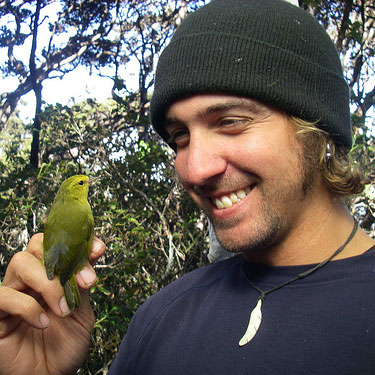
Graduate student Peter Motyka investigated the use of non-native forest by native birds to facilitate informed management of non-native forest for the benefit of native forest bird species. The project included color-banding and resighting Maui ‘Alauahio, quantifying vegetation structure for foraging habits, conducting variable circular plot point counts for bird densities, and nest searching and monitoring.
Because of this study on native bird use of non-native forest, MFBRP continues to conduct point counts and monitor native bird disease prevalence studies in non-native forest sites.