Disease Research
Understanding Disease and Mosquito Impacts
Avian Disease
Hawai‘i’s birds face a unique and deadly threat: non-native avian diseases spread by invasive mosquitoes. Hawai’i’s native forest birds evolved in isolation over millions of years, resulting in an extraordinary example of adaptive radiation. These birds developed without the many threats that are now present on the islands. Lacking natural defenses, two diseases—Avian Malaria and Avian Pox—have caused extinctions, range reductions, and extreme population declines among native forest birds.
While avian malaria is common and often mild in other parts of the world, this disease has devastated Hawai‘i’s native honeycreeper populations across the islands. Controlling mosquitoes is now essential to halting disease transmission and giving honeycreepers a chance at recovery.
Controlling mosquitoes is now essential to halting disease transmission and giving honeycreepers a chance at recovery.
Mosquitoes and the Hawaiian Islands
Before humans arrived on the islands, there were no mosquitoes. By the mid-1800s, mosquitoes were firmly established due to human activities. The southern house mosquito (Culex quinquefasciatus), introduced in 1826, is the primary vector of Avian Malaria and Avian Pox, driving declines and extinctions of many native forest birds.
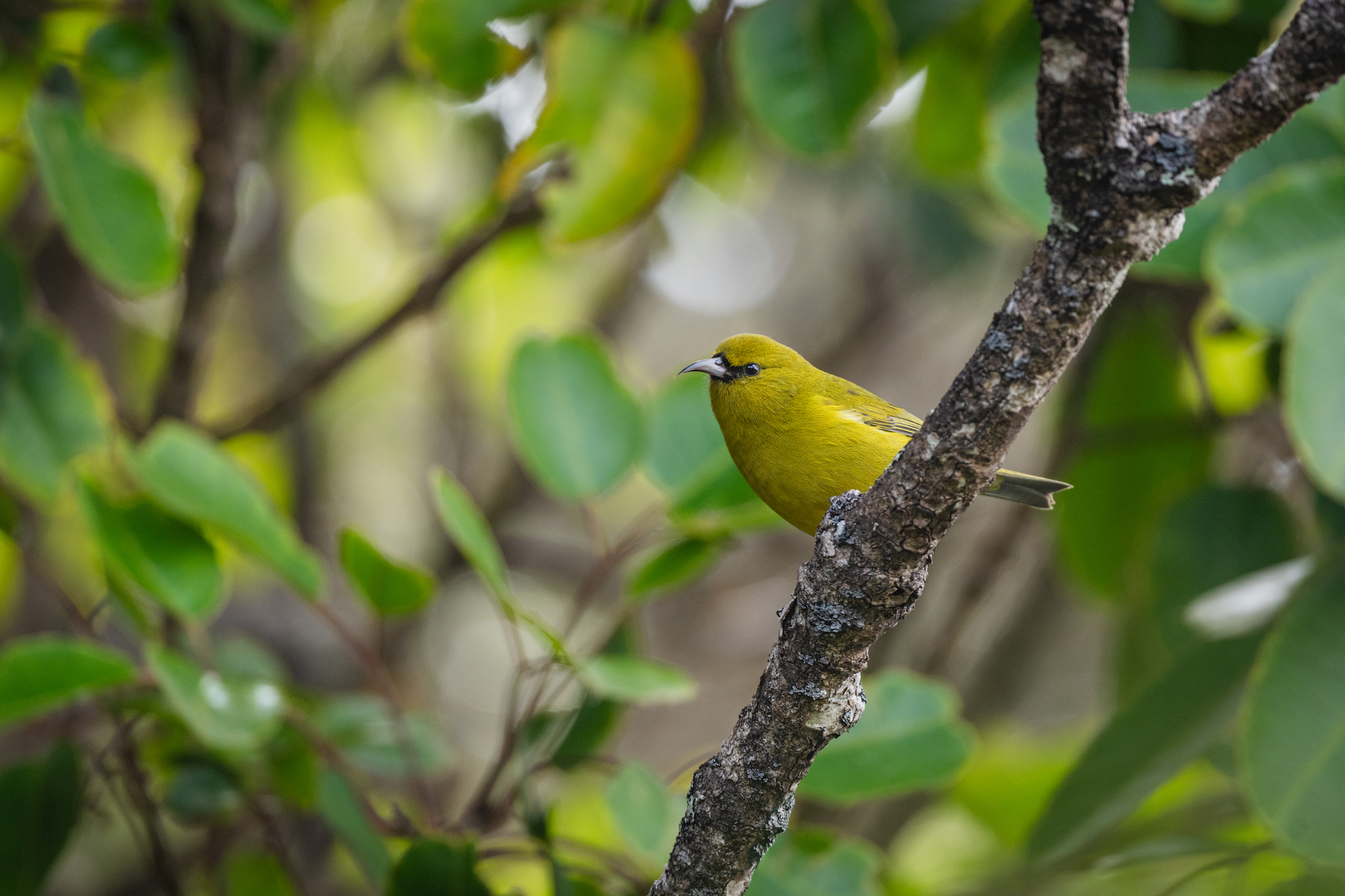
Most native Hawaiian honeycreepers now only persist in high-elevation native forests, such as those found on the northeastern slopes of Haleakalā on Maui, above ~5,000 feet (~1,200 m) elevation, where cooler climates prevent mosquito survival and malaria parasite development. Species like Kiwikiu and ‘Ākohekohe once thrived in low- and mid-elevation forests but are now restricted to small portions of their historic range due to mosquito-borne diseases. Although some suitable habitat remains at lower elevations, it is largely uninhabitable; birds venturing lower in elevation are likely to become infected and die. Climate change is exacerbating this crisis, as rising temperatures allow mosquitoes and disease to invade higher elevations, further shrinking the already limited range of Maui’s native forest birds.

The Diseases
Avian Malaria was first detected in Hawai’i in the 1940s and is caused by the unicellular microorganism, Plasmodium relictum. It is only spread by mosquitoes, which are essential to the parasite’s life cycle. The disease infects birds’ red blood cells, causing them to rupture and leading to low blood oxygen levels. It also results in enlargement and damage to internal organs such as the liver and spleen. Hawaiian honeycreepers, with no immunity to the disease, quickly become anemic, lethargic, and often die. Individuals which survive the initial stage of infection may remain chronically-infected for life. This weakens their immune system and turns them into persistent reservoirs for further transmission.
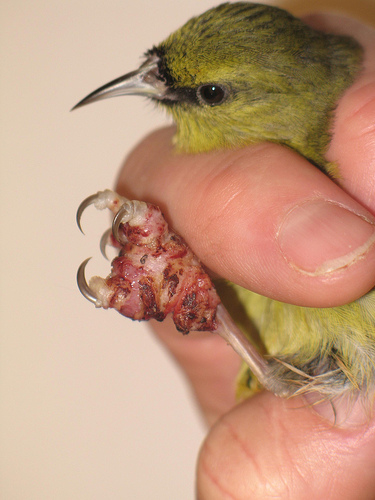
Avian Pox Virus was first documented in forest birds in 1902. It is primarily transmitted by mosquitoes but can also spread by direct contact between infected birds, contaminated surfaces, and contaminated food and water. Symptoms include swollen, tumor-like lesions on unfeathered parts of a bird’s body, such as the feet, legs, eyes, and base of the bill, as well as lesions in the mouth, trachea, esophagus, and lungs. These lesions can impair a bird’s ability to eat, forage and fly. Infected birds that do not succumbed to the disease may become weak and emaciated, making them susceptible to depredation.
Disease Control and the Future
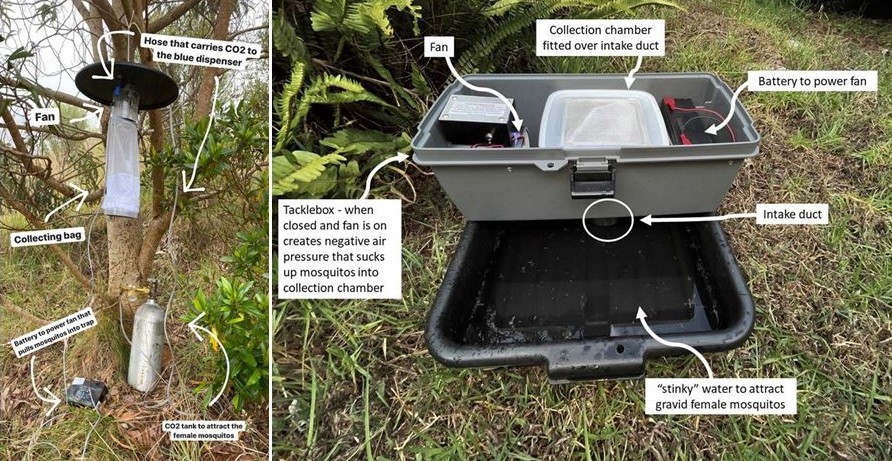
Both diseases are very difficult to manage. There presently is no feasible treatment or vaccines. The most important disease control methods currently are to limit mosquito populations, which can be difficult. Control programs need to be innovative, cost-effective, environmentally safe, and sustainable. We are currently implementing mosquito control efforts and to see what MFBRP is doing, check out Disease Research and Mosquito Control.
The continuation of our native forest bird populations depends on the preservation of their habitat, elimination of mosquitoes and disease, public outreach and education, vigilance in anticipation of future diseases or population declines, continued research on the native birds and their habitat, and continued laboratory research into innovative disease control methods.
Vanishing Voices: Saving our Hawaiian Forest Birds
Below is a short documentary about mosquitoes, their impact on native forest birds, and the ongoing efforts to protect Hawaiian honeycreepers.